Journey to the West: How the Monk Freed the Monkey
We continue the great Chinese epic about the Monkey Warrior, Sun Wukong, who must escort the Buddhist monk Tripitaka on his long journey to India to fetch the sacred scrolls. But first, Tripitaka must rescue Sun Wukong from his prison beneath a mountain, where the mischievous Monkey has been trapped for 500 years.
The Journey to the West How the Monk Freed the Monkey
Read by Jana Elizabeth and written and adapted by Bertie for Storynory.
Please support Storynory in any way you can. We have been sharing free stories with families for 21 years.
Hello, this is Jana, and I’m here with a story from China about a monk and a super-powered monkey.
Previously, we heard how the Monkey, Sun Wukong, fought the armies of Heaven. His favourite weapon was an iron staff that he could shrink to the size of a pin and keep behind his ear. But eventually he met his match — the Buddha himself.
The Buddha was a prince born in the mountains of India. He gave up his life of luxury and set out on a search for truth and inner peace.
In this story, he is also the most powerful spiritual being in the universe. He trapped Sun Wukong beneath a mountain, where the Monkey remained for five hundred years.
When the monkey had spent 499 years under the mountain, the Emperor of China wanted to bring the Buddha’s holy teachings to his people. The sacred writings were far away in India.
After calling all the holiest monks to his palace, he chose Tripitaka to fetch the writings. His epic mission was known as The Journey to the West.
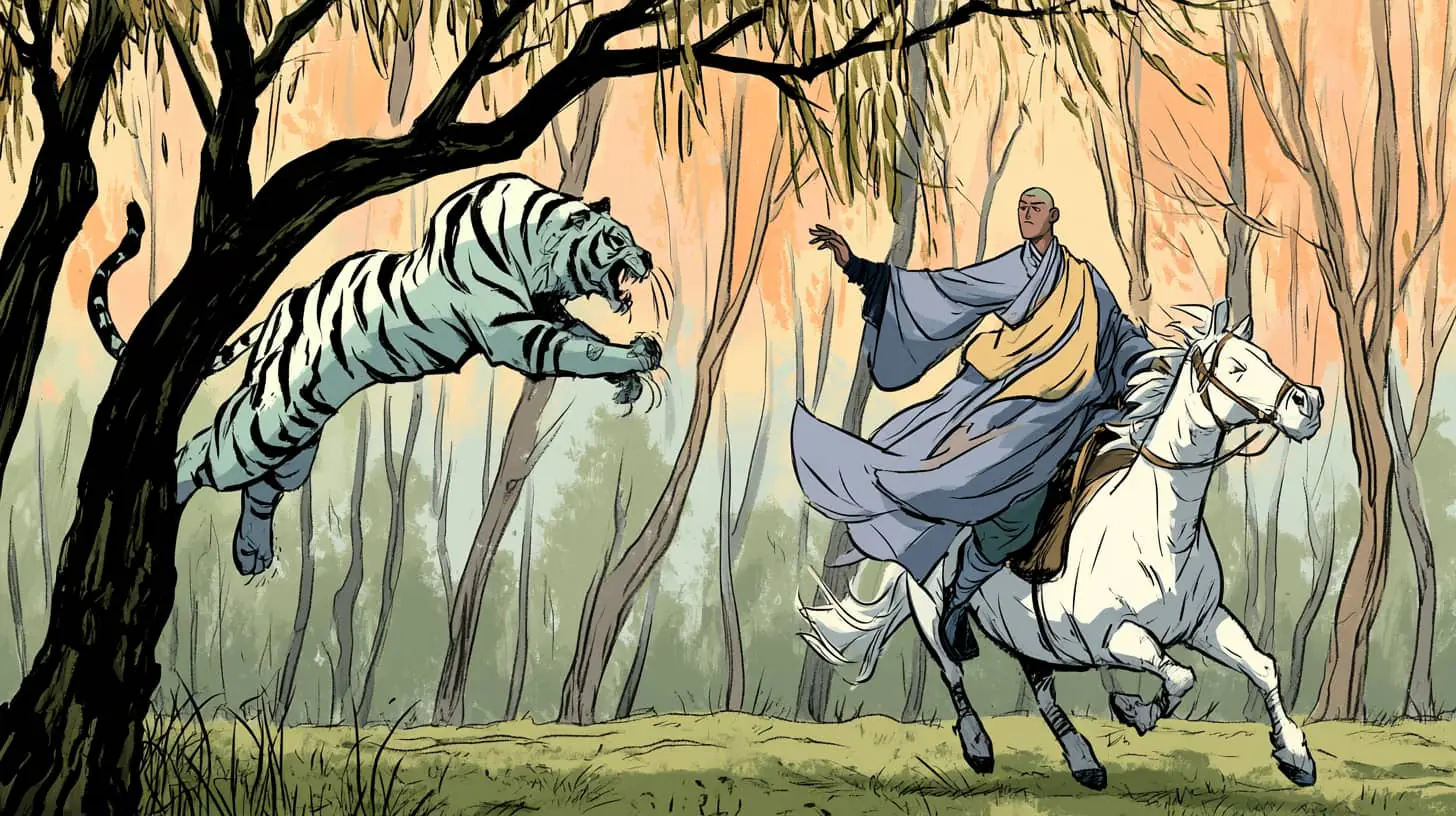
Tripitaka set out on his white horse, picking his way across mountain passes and travelling across deserts, until he reached Double Forked Mountain. He followed the path that led through the forest, up and around the mountain.
Towards evening, a tiger jumped down from a tree and landed in front of him. It snarled, and dribbled hungrily.
Tripitaka’s horse reared up, causing the monk to fall to the ground. He squeezed his eyes tight, believing that his journey was already at an end.
A second later, a hunter also jumped down from a tree and fought the tiger with his bare hands.
When the roaring stopped, the monk wondered if he had gone to Nirvana, a place that Buddhists believe is even more peaceful than Heaven.
Gradually, he opened his eyes and saw that the hunter had defeated the tiger.
The hunter bowed to Tripitaka and said:
“Your holiness, follow me. It will be my great honour if you eat with my family and stay under our roof tonight.”
When they arrived at the hunter’s hut, the monk was surrounded by his children, who sang songs and asked him to tell them tales of his travels. Meanwhile, the hunter and his wife prepared roast tiger for dinner.
After hours of cooking, they sat down to eat, but Tripitaka did not touch the food.
“I am most embarrassed,” he said, “but in all my humble life I have never eaten meat.”
The family was just as embarrassed as he was. They had not realised that Buddhist monks are vegetarian.
They hastily cleaned up the pots and cooked vegetable soup. It was very late indeed when they eventually had time to lie down and sleep.
In the morning, the hunter walked with Tripitaka as far as the border of Tang, as China was called back then.
“I am not permitted to go one step further,” said the hunter. “Beyond this place lie the lawless lands.”
Tripitaka was fearful that he would soon be eaten by a tiger or attacked by robbers. However, as he bid farewell to the hunter, they both heard a voice.
“Hey! Are you that monk who’s on his way to India?”
“Who said that?” demanded the hunter, drawing his knife.
“I did. Come over here, quick, and let me out. I’ve been stuck here for five hundred years, and I’m bored silly. Hungry too.”
The hunter moved towards the voice, and discovered two brown eyes peering through the tiniest window in the rocks.
“Not you,” said the monkey rudely. “The monk!”
When Tripitaka joined them, Sun Wukong – for it was he – explained:
“I was born the Stone Monkey King of Flower-Fruit Mountain. The Jade Emperor gave me a job in Heaven, first as keeper of his horses, and then as chief gardener in a sacred orchard. When I rebelled and fought his army, there was absolutely nothing he could do to defeat me. But then the Buddha tricked me, and here I am, stuck under this mountain. I’ve pleaded with him, and promised to be good. His disciple, the Bodhisattva Guanyin, told me that you would come along eventually. Only you can free me, reverend monk, and I must protect you on your Journey to the West.”
Tripitaka knew well that once he crossed the border into the lawless lands, he would face bandits, demons, and worse.
Who better than a magical monkey warrior to be his bodyguard?
“Very well,” said the monk. “How do we get you out of there?”
“You must climb to the top of the mountain and fetch the mantra that is written on an orange piece of paper. When you bring it down to me, I will be set free.”
The climb up the mountain was not easy. In places, the rock face was like a wall. The hunter went first, clinging on with his fingernails, and then hauled the monk up with a rope made of vines.
When they reached the windy summit, they found the orange piece of paper. On it, in Chinese letters, were written the words:
Om Mani Padme Hum
Om is the sacred sound of the universe.
Mani means jewel, and represents love and compassion.
Padme means lotus, and represents wisdom.
Hum means together, the joining of compassion and wisdom.
A sacred phrase like this is known as a mantra, and Buddhist monks chant mantras over and over again to calm the mind and draw closer to truth.
In this case, when Tripitaka sat down and repeated the mantra a few hundred times, the door to the Monkey’s prison cell flew open.
“Free at last!” declared Sun Wukong. “I haven’t felt this good – or this hungry – for five hundred years!”
And that was the story of how the monk – Tripikata – set the monkey – Sun Wukong free after he was imprisoned for 500 years under a mountain. It was adapted for Storynory, by Bertie. The monkey and the monk continued on their Journey to the West, collecting more fantastical companions, and meeting demons and monsters. I’ll be back with some more episodes soon.
For now, from me Jana, Bye Bye