The Dutch Hotel – Déjà Vu
Have you ever walked into a place and thought, “I’ve seen this before” – even when you know you’ve never been there. This episode of our spooky series The Dutch Hotel explains why you might get that feeling sometimes.
Hello, This is Jana, and welcome to Storynory.
This story is dedicated to Adam, Yarden & Neta who asked us to do something just a bit spooky.
The Dutch Hotel is not just famous for being haunted. It is also known for the best Dutch pancakes in London. Well, naturally, given its name and history, they had to hire a pancake chef from Holland. And just in case you are wondering, he is a live chef, not a ghost.
At 7.22 a.m., Captain Errol Fenn landed his Boeing 747 from Boston at Heathrow Airport.
Before taking a nap, the one thing he was looking forward to was a good breakfast.
His co-pilot, who was half Dutch, recommended the pancakes at the Dutch Hotel.
Still wearing his pilot’s uniform, he took a black cab straight there. The fare was almost as much as a return flight to New York, but never mind, he was hungry.
He was still feeling the effects of the red-eye flight as he walked into the lobby. As he entered, a sensation came over him that was more than simple weariness. It was a strong sense of déjà vu- a feeling that he had seen all this before, perhaps in a dream, or somewhere long ago.
And yet, until that very morning, he had never even heard of the Dutch Hotel. And despite having visited most of the countries in the world, he had never even tried Dutch pancakes.
“Goodmorning. I’m looking for a spot of breakfast,” he told the smart-suited usher.
“This way, sir,” said the usher, leading him towards the lounge.
Strangely, the captain already knew it would be on his left.
The room opened out around a marble fountain. A classical water nymph poured a steady stream into the basin below. There were leafy green plants everywhere – potted palms and trailing vines. The mood was unrushed, but also quite businesslike. Many of the guests were dressed for meetings.
He chose a table by a large ornate window and looked out onto the rainy London street. He was lost in thought when the waiter brought the menu. He looked at it, feeling he was half in a dream.
His eye was drawn to the section on Dutch pancakes, but suddenly he had a change of heart.
“I’ll try the tiropita, please.”
Tiropita is another speciality of the hotel, though it is not Dutch at all. It is a Greek pastry filled with cheese. It appears on the menu partly because the hotel’s administrator, Angeliki, is Greek. In case you don’t remember, she is the mother of Nafsi and Yogi – the two children who have a knack for travelling back into the hotel’s past.
As it happened, just as the Captain was taking his first bite, Angeliki was walking past. She could not help asking.
“How’s the tiropita, sir?”
“Oh delicious, thank you. It brings back memories,” said the captain.
And then he looked up at her again.
She seemed strangely familiar.
“You know, I just arrived here, but I feel like this is a home from home,” he said.
“Aw that’s a lovely compliment,” smiled Angeliki, obviously pleased.
“Have you ever had that experience, that you’ve been somewhere before, even when you know that you haven’t? I think they call it déjà vu.”
“I haven’t personally,” replied Angeliki thoughtfully, “but it’s not unusual for the guests here to have slightly uncanny experiences. Some say the hotel is haunted.”
“Is it? What’s your opinion?”
“Me? I’m not sure,” said Angeliki. “But my son, well he’s certain it’s haunted, aren’t you?”
Yogi had come down for pancakes as they were talking.
“Oh yes. The hotel is definitely haunted. For example, I bet you didn’t notice that the waiter who brought your cheese pastry is a ghost,” said Yogi.
“A ghost?” said the Captain with a smile.
“Yeah, he died 100 years ago.”
“I hope the pastry isn’t that old!” he said laughing.
“It might be.”
“Ahh,” said the captain, seeing breakfast in a new light.
“Don’t worry sir,” reassured Angeliki, “your pastry was made freshly this morning here in the present.”
“Well if I may, can I ask you a strange question? Is there a hotel just like this one, only in Athens?”
“If there is, I’ve not heard about it. I have Greek family connections and I think they would have told me.”
“It’s just that I feel that I was there, when I was about your son’s age, 45 or so years ago.”
“That’s totally possible,” said Yogi. This hotel has all sorts of strange connections. And if you like, my sister and I can travel back in time and check it out,” replied Yogi.
“Well I wouldn’t want to put you and your sister to any trouble.”
“No problem. We like time travelling, Besides, it’s the holidays and Mum and Dad are too busy to take us anywhere. What date should I set my watch for?”
“That’s a very smart digital watch,” said the Captain admiringly. “Set the time zone for Athens and the date for 1st July 1983.”
Done. We’ll take some pictures,” said Yogi.
“In that case, you’ll need a proper camera,” said the Captain.
Now you might think that the Captain was joking. But he was no stranger to the strange. When flying above clouds, he had seen some very odd things with his own eyes. Later that morning, he returned with a small rucksack. Inside it was a film camera, a wad of money in Greek Drachma notes with dates like 1979, and a Walkman with a cassette of Michael Jackson songs.
The following morning, Yogi and his sister Nafsi pushed off on their scooters over the cobbled stones of the back mews. As always, it was a bumpy ride. But shortly, they were riding along a narrow pavement on a hot side street in central Athens. The air was filled with loud beeps of tinny looking cars and motor scooters. The tourists ambled along in khaki shorts, flowery shirts, print dresses, straw hats, and flip flops.
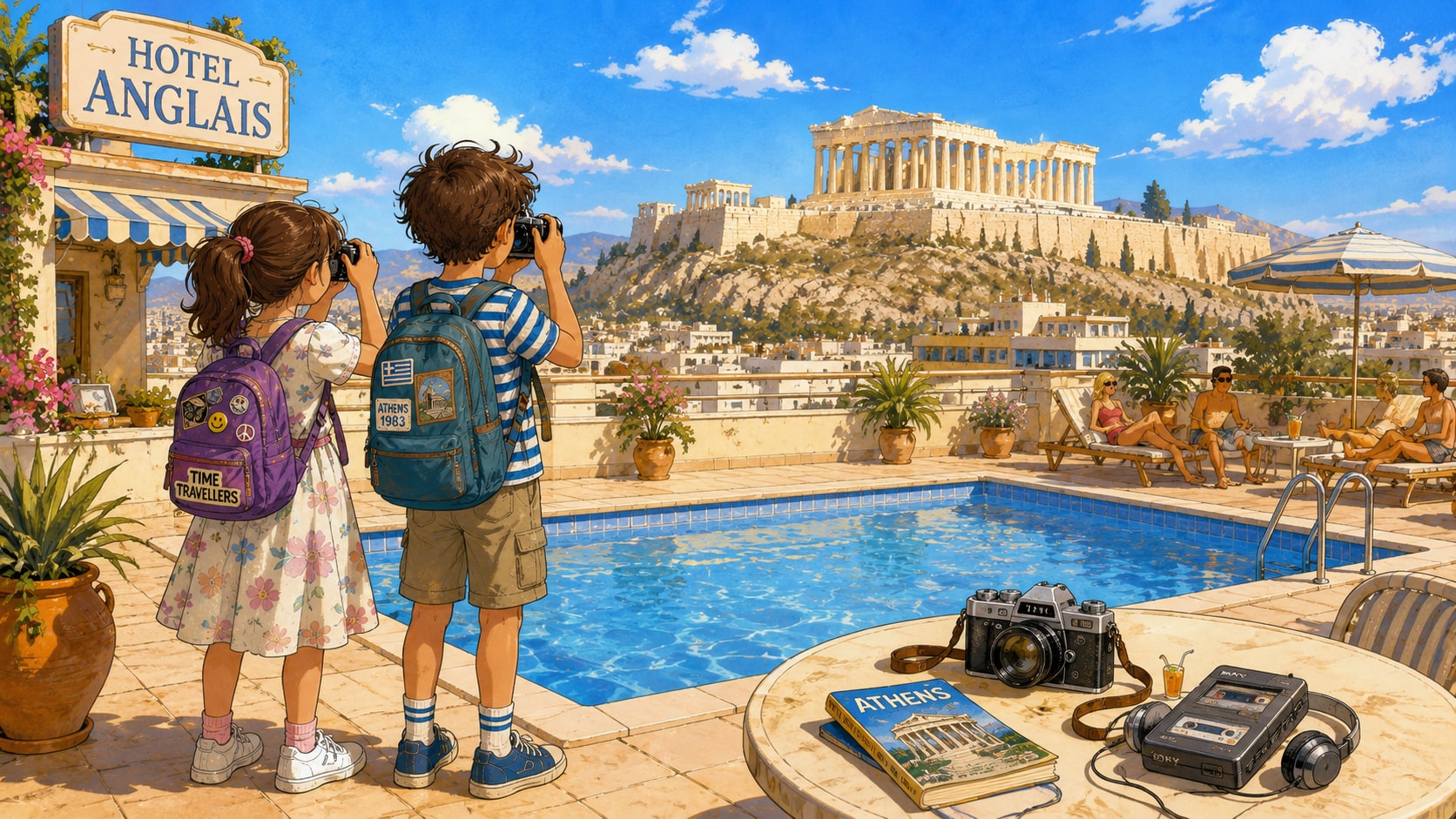
There were many hotels to choose from, but only one had the same steps and London-like columns of the Dutch Hotel. It was called, appropriately, “Hotel Anglais.”
When they stepped into the lobby, Yogi and Nafsi looked around. It looked the same, but different. In a word, it felt more relaxed. The stairs and the reception desk were in the same place as back home. There was marble everywhere. But the marble was slightly warmer, and less perfect. It had more zig-zaggy lines. The staff were smart, but dressed in white jackets – not quite so fitting as the suits the London staff wore.
But then again, hotel lobbies are all a bit the same wherever you go. They knew the real test would come when they went into the Lounge. And yes, there it was! The indoor fountain with a classical statue spouting water. Not quite the same water nymph, but very similar.
“Let’s see if the Greek money works,” said Yogi. So they sat down by the window and ordered ice cream.
“Do you think the waiter is a ghost?” whispered Yogi.
“I’m not not sure, it’s hard to tell,” said Nafsi.
But then she looked up and saw a face she recognised. Or almost recognised.
“Excuse me, is your name Angeliki?”
The woman looked like a younger version of their mother.
“Very close,” said the woman, “I’m Angela.”
“And are you the manager here?”
“Yes, is there anything I can do for you?”
“No, everything is fine,” said Nafsi shyly.
“Is your husband called Alan?” asked Yogi not at all shyly.
“He’s called Aleko. He’s Greek. I’m English. We run the hotel together.”
“We thought so,” said Yogi. “And do you have any children?”
The woman smiled. “Not yet, we’re too busy.”:
“Well when you do, be sure to call them Nafsi and Yogi.”
“Those are nice names. Now, if that’s all, enjoy your ice creams – I’ll tell the waiter to put them on the house – and if there is anything you need, just ask,” said the woman who wasn’t quite their mum.
They went back into reception and stopped at a stand showing a picture of the roof terrace. It had a swimming pool.
“Well that’s different,” said Nafsi.
They decided to go up in the lift. This one was slower and more noisy than the lifts in London. It was operated by a man in a smart uniform who pulled a handle to start it.
When they reached the top, the view was wonderful. People lounged around the pool, some of them turning a little pink in the sun. From far below came the sound of cars and motor scooters. And beyond the rooftops, rising above the city, was a brilliant sight.
“That’s Athena’s temple. It’s called the Parthenon,” said Nafsi, pointing to the shining white building on the hill that is known as the Acropolis.
“Let’s take a picture,” said Yogi.
He rummaged through the rucksack and pulled out the old-fashioned camera. He squinted through the little window, adjusted the focus, and pressed the button.
“Click!”
Then he took some pictures of the pool.
“Click! Click!”
“This is cool,” said Yogi.
When they returned downstairs, Angela met them in reception.
“I believe this is for you,” she said.
She handed them an envelope addressed to Yogi and Nafsi. Inside were two tickets to visit the Acropolis and two air tickets to London the following morning.
“But we came here by scooter,” said Yogi.
“You can check your scooters in as luggage,” said Angela.
“And what about our passports?” asked Nafsi.
“Reception has them for you.”
And it was true. Behind the desk were two black British passports, along with a large key marked Room 44.
“This is really strange,” said Nafsi.
“Strange is normal when you go time-travelling,” said Yogi.
In their room, a battered suitcase was waiting for them. It was covered in old travel labels – Panama City, Cairo, Port Moresby.
Inside were clean clothes. They washed, changed, and rested for a while before a taxi took them to the Acropolis.
It was a steep climb in the hot sun, but it was worth it. The ancient temple looked as if it had just been built.
“Snap! Snap!” went Yogi’s camera.
They gazed up at the long band of carvings circling the temple, showing a great procession of horses and people. Inside stood a gleaming statue of the goddess Athena. And around the side they visited the Porch of Maidens, where the roof was held up by statues of young women.
That evening they ate in the hotel restaurant — lamb souvlaki, fresh Greek salad, and, best of all, plenty of chips.
In the morning, a hotel limousine took them to the airport. As they drove through the city, they passed rows of pale houses with balconies and shutters.
The driver helped them check in, and a stewardess showed them to the departure gate. They felt like VIPs!
The plane rattled and shook as it sped along the runway, and as it lifted into the air they caught sight of the gleaming sea far below, and a rocky headland with a temple standing high above the waves.
When the seatbelt and “no smoking” signs were turned off, the stewardess came down the aisle.
“The Captain would like to say ‘hello” to you,” she said.
She led them up front to the pilot’s cabin.
“Greetings Kids,” said Captain Fenn, who was wearing a pilot’s headset. “Did you enjoy your trip!”
“It was amazing, thank you,” said Nafsi.
“We took loads of pictures for you!” added Yogi.
They told him all about the hotel, how it was almost the same but different, about how they met a woman who was not quite their mum, and about the trip to the Parthenon.
“Did you have a feeling that you had been there before, like in a dream?” asked the Captain.
“We did,” said Nafsi. “It was kind of eerie, but in a good way.”
“That’s like déjà vuall over again!” said Captain Fenn.
When they returned home to the Dutch Hotel, everything looked exactly the same as when they had left it.
But somehow, it felt slightly different.
Their father took the film to be developed and printed into proper photographs.
The following week, Captain Fenn was back in London and came to the hotel for breakfast. Yogi and Nafsi could hardly wait to show him the pictures.
He opened the envelope carefully with a breakfast knife.
“It was much more exciting in those days,” he said, “when you had to wait to see your holiday photographs.”
He began to flick through them.
“Hmm,” he said. “What’s this?”
He held up a picture of the temple.
“The Parthenon,” said Nafsi.
“Yes,” said the Captain slowly. “But look at it.”
“That’s it. It’s a temple.” said Yogi.
“The thing is,” said the Captain. “Part of it was destroyed long ago. When the Turks ruled Greece, they stored gunpowder inside it. And one day, Boom!”
“It looked complete when we saw it,” said Nafsi.
He turned to the next photograph.
“And these stones you see around the top of the temple. They are called the Elgin Marbles. The carvings show a procession from ancient Athens. One hundred years after the temple was blown up, Lord Eglin picked up the marbles and brought them to London. They are here to this day, inside the British Museum. Some people say they should be back in Athens. But nonetheless, London is where they are. At least… in this universe.”
The next photo showed the rooftop of the hotel and the pool.
And standing by the edge, squinting into the light, was a boy about Yogi’s age.
The Captain looked at it for a long moment.
“Can you guess who that is?” he said quietly.
“I don’t remember seeing him. Is he famous?” asked Nafsi.
The Captain smiled.
“Not exactly,” he said.
“That’s me.”
And that was a story called ‘déjà vu’ from our spooky series, the Dutch Hotel.
And I’m delighted to dedicate this story to Adam, Yarden & Neta. Their mum writes. We love listening to Storynory on long drives or when relaxing at home. We’ve been listening for years and some of our favourites include the Wicked Uncle and Dutch hotel series as well as the Bertie stories. We’re always so excited when a new story comes out and look forward to hearing many more Storynory tales.
And if you would like to help keep Storynory on the air, please visit our website to see ways that you can support us. I think it’s fair to say that we do genuinely need your help to keep going and we appreciate anything you can do.