The Hedley Kow
A funny tale from the North of England about an old lady who is always cheerful, no-matter what.
And listen on at the end for an amusing and buzzy story from our listener Aarav in Mumbai.
The Hedley Kow
Hello, this is Jana, and I’m here with a short and funny folk tale from Northumberland, in the north of England. In the village of Hedley, people used to tell stories about a mischievous magical creature called the Hedley Kow. And it loved playing tricks.
THERE was once an old woman, who used to do odd jobs. She went around the houses. Sometimes she did some washing and earned a plate of boiled potatoes. Other times she took the horse out to feed in the meadow and the farmer’s wife gave her a nice cup of tea. It wasn’t much, but the jobs kept her alive, and she always had a smile on her face. To look at her, you would think she didn’t have a care in the world.
Well, one summer evening as she was walking home, she came upon a big black pot lying at the side of the road.
“Now that,” said she, stopping to look at it, “would be just the very thing for me if I had anything to put into it! But who could have left it here?” and she looked round about, as if the person it belonged to must not be far off. But she could see no one.
“Maybe it has a hole in it,” she thought.
“Ay, that’ll be why they threw it out. But even if it has a hole in it, I could use it as a flower pot. I’ll just take it home, anyways.” And she bent her stiff old back, and lifted the lid to look inside.
“Mercy me!” she cried, and jumped back to the other side of the road; “if it isn’t brim full of gold PIECES!!”
For a while she could do nothing but walk round and round her treasure, admiring the yellow gold and wondering at her good luck, and saying to herself about every two minutes, “Well, I do be feeling rich and grand!”
But gold is heavy – too heavy to carry. She began to think how she could best take it home with her. At last she decided the best thing to do was to fasten it to her apron and drag it along the road.
“It’ll be soon dark,” she muttered to herself. “Which is a good thing. I don’t want folk to see what I’m bringing home with me, and I’ll have all the night to myself to think what I’ll do with it. I could buy a grand house and all, and live like the Queen herself, and not do a stroke of work all day, but just sit by the fire with a cup of tea; or maybe I’ll give it to the priest to keep it safe for me, and to hand me a piece of gold every now and then when I need it. Or maybe I’ll just bury it in a hole at the garden-foot, and put a bit on the chimney, between the china teapot and the spoons—for ornament, like. Ah! I feel so grand, I don’t know myself rightly!”
She was already rather tired with dragging such a heavy weight after her, so she stopped to rest for a minute. As she caught her breath, she looked inside the pot to make sure her treasure was safe.
But when she peered inside, there wasn’t a pot of gold at all, but a great lump of shining silver!
She stared at it, and rubbed her eyes and stared at it again; but she couldn’t make it look like anything but a great lump of silver. “I’d have sworn it was a pot of gold,” she said at last, “but I reckon I must have been dreaming. Ay, now, that’s a change for the better; it’ll be far less trouble to look after silver than gold. There will be fewer wagging tongues, and fewer thieves after my loot. Those gold pieces would have been a sight of bother to keep ’em safer. Ay, I’m well rid of them. And with this lump of silver, I’m as rich as I ever need be.
And she set off homewards again, cheerfully planning all the grand things she was going to do with her money. It wasn’t very long, however, before she got tired again and stopped once more to rest for a moment or two.
Again she turned to look at her treasure, and as soon as she set eyes on it she cried out in astonishment. “Oh my!” said she; “now it’s a lump of iron! Well, that beats all; and it’s just real convenient! I can sell it as easy as easy, and get a lot o’ penny pieces for it. Ay, iron is much handier than a lot o’ yer gold and silver that would only have brought me worry. Those riches would have kept me from sleeping at nights for fear the neighbours were robbing me—and iron is a real good thing to have by you in a house, ye never can tell what ye might use it for. Or sell it. Rich? I’ll be just rolling!”
And on she trotted again chuckling to herself on her good luck, till presently she glanced over her shoulder, “just to make sure it was there still,” as she said to herself.
“Oh my!” she cried as soon as she saw it; “if it hasn’t gone and turned itself into a great stone this time! Now, how could it have known that I was just in need of a stone to hold my door open with? Ay, if that isn’t a good change! It’s a fine thing to have such good luck!”
And, all in a hurry to see how the stone would look in its corner by her door, she trotted off down the hill, and stopped at the foot, beside her own little gate.
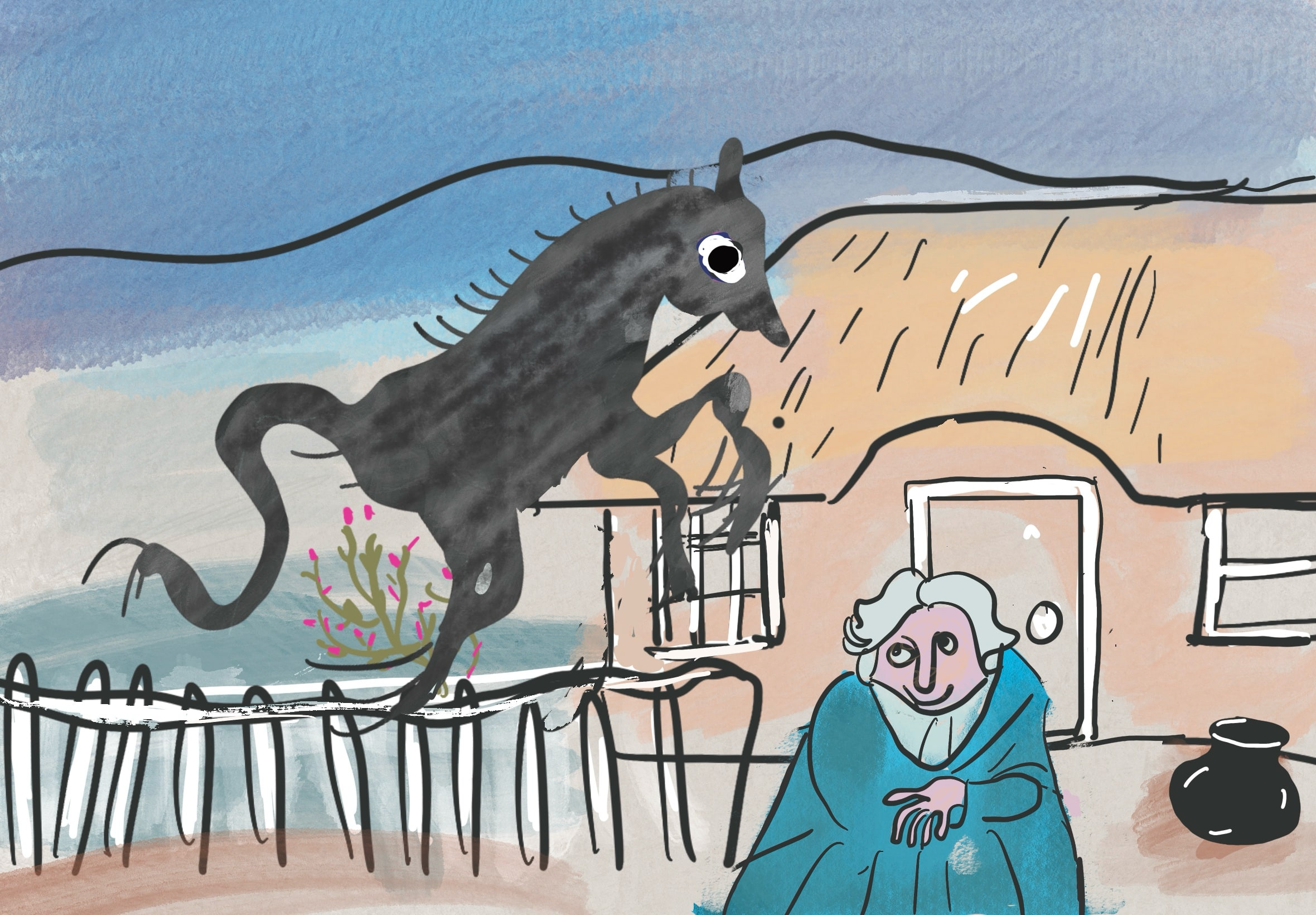
When she had unlatched it, she turned to unfasten her shawl from the stone, which this time seemed to lie unchanged and peaceably on the path beside her. There was still plenty of light, and she could see the stone quite plainly as she bent her stiff back over it, to untie the shawl end; when, all of a sudden, it seemed to give a jump and a squeal, and grew in a moment as big as a great horse; then it threw down four lanky legs, and shook out two long ears, flourished a tail, and galloped off kicking its feet into the air, laughing like a naughty mocking boy.
The old woman stared after it, until it was fairly out of sight.
“Well!” she said at last, “I do be the luckiest body hereabouts! Fancy me seeing the Hedley Kow all to myself, and making so free with it too! I can tell you, I do feel that GRAND——”
Now, the old woman had heard stories about the Hedley Kow all her life. It could change its shape into almost anything, and there was nothing it liked better than making fools of people. So that was who she had been dragging home!
“Well!” she said. “Some folk go their whole lives without seeing anything magical. And here’s me spending the evening with the Hedley Kow! Wait till I tell the neighbours. A pot of gold would have been very nice, but this will give us something to talk about all winter!”
And with that, she went into her cottage and sat down by the fire to think over her good luck.
And that was The Hedley Kow, read by me Jana for Storynory!
Drop by soon for more exciting stories!
But before I go, here’s Bertie with a little story from a fan in India.
By Aarav, aged 7, from Mumbai, India (and hello to his mum, Divya)
The Sandpit
There was a beehive. And in the beehive, were two friends. Their names were: Buzzy and No-Buzzy. But even though they looked the same, their traits are super-duper different. Buzzy liked to be unsafe, while No-Buzzy liked to be safe and tried to keep Buzzy safe. So let’s continue the story!
So one day, Buzzy and No-Buzzy were flying in the beehive doing nothing. Buzzy said,
“Whew, this is
boring”. No-Buzzy said,
“How is this enough
honey? Let’s work too!” Buzzy said,
“Nah, that’s also boring. I saw a sandpit nearby. Let’s play in it.” And then she flew away. No-buzzy shouted, “Buzzy, we bees can’t sustain sand!”. But it was too late!
Buzzy was sick. Paara walked by and No-Buzzy stopped her. She told Paara to take Buzzy to the clinic doctor. Paara did as told and the clinic doctor gave Buzzy two injections – one for the brain, and another to remove sand. And the clinic doctor injected the second injection on his own earlobe – sending everyone into a laughing riot. And then the doctor said,
“Buzzy you can go. That much laughter can cure you. But next time, go to the strict doctor. That will be a relief for me for some time!”. And then Buzzy left, calling out, “Alright, everytime we’ll come to you only!”